

Las Flores – First Guest Conversation: Emma
- Shikin Xu

- Dec 27, 2025
- 12 min read
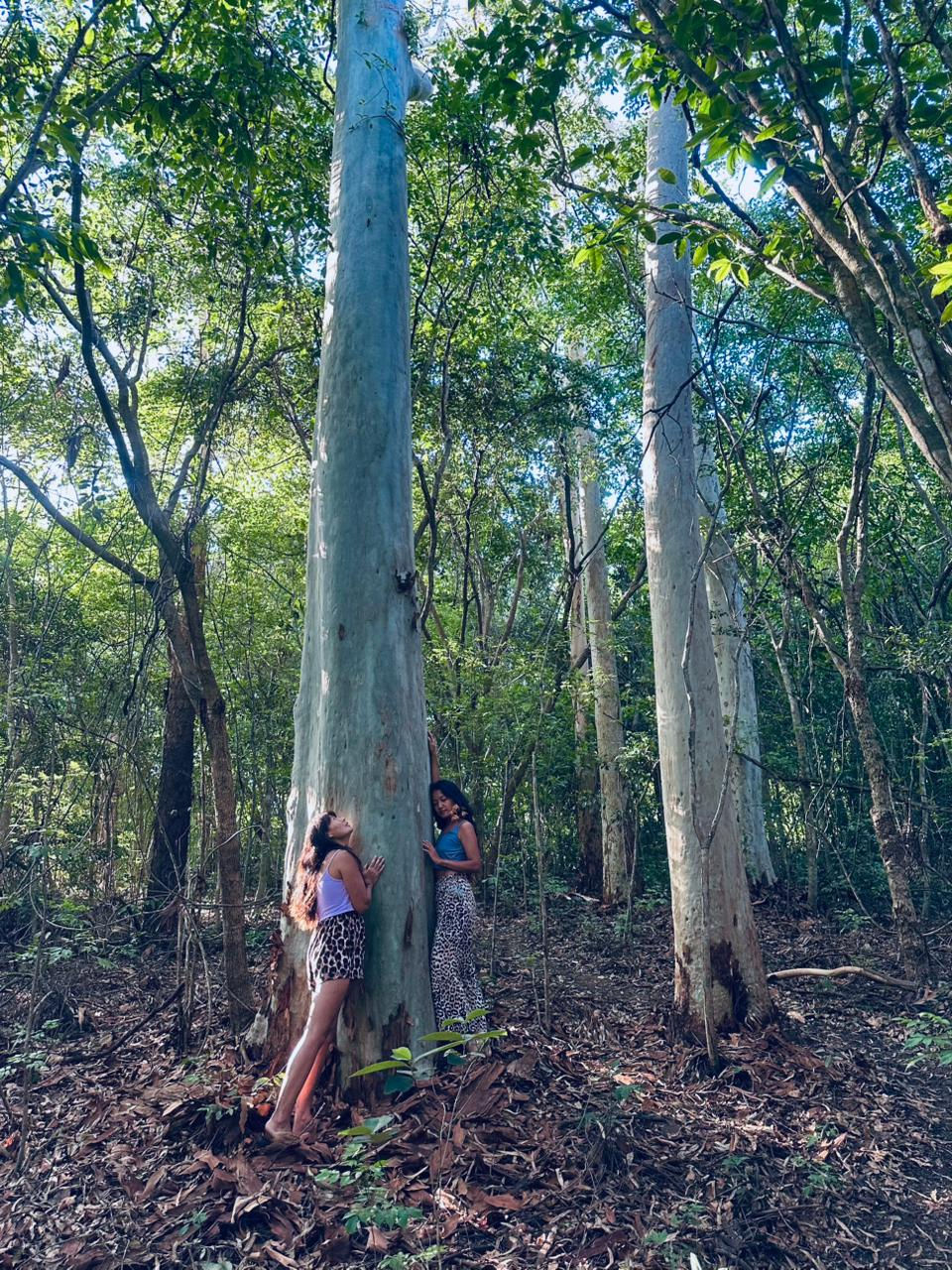
Sometimes friends aren’t the people you see every day.
They’re people who live in different corners of the same world—three years and many cities apart—yet one day, they are still opened by the same door.
Three years ago, she and I added each other on WeChat in Argentina because of a mutual friend, “Tianniu.”
Back then we hadn’t met, and we hadn’t even really had any deep conversations. We were simply watching each other’s lives from afar through Moments: bits of daily life, bits of geography, and the occasional mood.
Three years later, in Brazil, I walked into her home with a heart that had just been shattered. She opened the door as if opening a gentle way of living: cooking, the market, picking fruit, children’s laughter, the forest breathing. That feeling is hard to explain—it wasn’t being saved, it was being held.
This is the first guest conversation of Las Flores.
And it’s also the first time I’ve placed the words “travel, women, intimacy, growth, and healing” onto a real person, under a real roof.
---
Opening: When the door opens, we both return to life
Shikin:
Hi everyone, welcome to Las Flores. I’m Shikin. This is a podcast about travel, women, intimate relationships, and growth and healing.
I’m especially excited about today’s episode because this is the very first guest on Las Flores. She is a friend I first met online and later met in real life. Her name is Qian Gao, and you can also call her Emma.
Emma:
Hi everyone, I’m Emma. I’m really happy to meet you on Shikin’s podcast! I live in Brazil now, and I’m a full-time mom.
When I heard her say “full-time mom,” what came to mind wasn’t exhaustion, but a solid, grounded sense of steadiness and happiness.
---
01 | Buenos Aires three years ago: eight months pregnant, walking ten kilometers a day
Shikin:
Do you remember what state you were in three years ago when we added each other on WeChat in Argentina?
Emma:
I think I was about seven or eight months pregnant, and I was still walking nearly ten kilometers a day, moving through the streets and alleys of Buenos Aires.
I laughed right away—this is so Emma. Because I know Buenos Aires is a very walkable city: you walk under the shade of trees, past old buildings, through tango music, through the smell of coffee. But she was walking ten kilometers a day while eight months pregnant. Truly strong!
Shikin:
Then three years later, when we finally met in Brazil, in your home—what was your first reaction?
Emma:
It just felt like a very familiar friend. Even though we hadn’t met in person, we shared all kinds of updates through Moments, and I roughly knew what kind of person you were, so it didn’t feel unfamiliar.
Shikin:
Yes, I didn’t feel unfamiliar when I met you either. The first time we talked, I stayed at your place for two days.
I was really moved by this—because you opened your home and welcomed me. At that time I was in a very heartbroken stage, and being at your house felt like being warmed, like being held. You took me to pick fruit; we cooked together, went to the market, played with your two kids—everything was so beautiful. Thank you.
Emma:
You’re welcome. We also really enjoyed the time with you.
Some homes are “a place to sleep for one night.”
Some homes are “a place to live for two days.”
During those days, I wasn’t a tourist—I was someone being held by life and by a friend.
---
02 | The first real trip: one month of vacation, opening the world
I asked her: if we push that door further back, when was the first time you decided to step out?
Shikin:
How did you start traveling? Do you remember your first trip in the true sense of the word?
Emma:
Actually, I’ve dreamed of traveling around the world since I was little. When I was young, I didn’t have the chance. After I graduated and started working, suddenly I got an opportunity.
When I looked for jobs, I chose ones that offered a long vacation during the year. I happened to save up one month of leave, and then I set off for Southeast Asia.
Shikin:
After that trip, did you get a very clear signal—OK, this is the road I’ll be walking from now on?
Emma:
Because it was my first time, I gained so much, and it felt very accomplished. I also ran into some small difficulties on the road, but in the end I solved them.
After I came back, I felt like I had seen a very different world, and I fully enjoyed the whole process, so I really looked forward to traveling in the future.
When she said “a sense of accomplishment,” I thought of so many people setting out for the first time.
What they truly lack isn’t a plane ticket, but this kind of confidence: “I can handle the unknown.”
---
03 | Is travel escape or search? She said: not avoidance—opening
Shikin:
For you, is travel escape, or search?
Emma:
I think it’s both. And “escape” isn’t an accurate word.
If, in your normal life, you temporarily pull yourself out and give yourself a bit of space to discover something very different, and then return to your original life with more vitality—this kind of “escape” is actually good.
It’s not avoidance, it’s a kind of opening. Maybe in that new world you’ll find something that suits you better, and then bring what you saw or learned back into your life.
I really like how she translated “escape” into “opening.”
Because so many people are afraid to admit they want to leave, as if wanting to go means being irresponsible.
But she said: temporarily stepping out isn’t betraying life—on the contrary, it recharges life so it can continue.
---
04 | Her way of traveling: a backpack, a slow pace, valuing “people” over “attractions”
Shikin:
A lot of people want to travel long-term, but they’re afraid. What’s your travel mode?
Emma:
I travel as a backpacker—light, with a pack on my back. I choose a destination that I especially long for at a certain stage, and I go slowly—to see, to feel, to experience.
I’m not the kind of person who lists a bunch of sights and checks them off. I think the people you meet and the things you go through matter more. Of course, seeing beautiful scenery along the way is great too, but experiencing different customs and ways of life is especially important to me.
When she said “slow pace,” what I really wanted to say was: a slow pace means you’re willing to give yourself to the present.
---
05 | The most important principle of solo travel: safety (intuition, boundaries, attitude, mental steadiness)
Shikin:
What’s the most important principle when you travel alone?
Emma:
Ensuring safety.
Shikin:
How do you understand “safety”?
Emma:
Safety is very broad. I think the more you go out, the more open your senses become, and the better your judgment of unfamiliar places and people gets. You’ll instinctively know what’s safe, who you can get close to, and who you should keep your distance from.
I strongly agree with this:
In the end, solo travel isn’t about strategies or itineraries—it’s about the ability to recognize your own feelings.
I asked her about the Vietnam story—because it contained a key sentence of hers: don’t be timid, but stay steady.
Emma:
That time in Vietnam left a deep impression on me. We agreed on the price before I got on the rickshaw, but the driver took me to a relatively remote place and tried to raise the price to about ten times, and his attitude was very nasty.
I didn’t panic. I thought for a moment, and said very firmly: no. Either you take this amount, or I call the police.
Attitude matters. Don’t be timid—but inside I was still a bit scared afterward.
So ensuring safety while traveling is very important: trust your intuition, keep your ears open, mental steadiness is important too—stay steady.
As I listened, I suddenly thought of one experience I had in Egypt.
Shikin:
A friend and I went rock climbing and hiking. The driver took us deep into the Sinai Peninsula—no signal—and then suddenly tried to change the price. After we refused, he started having a meltdown, acting crazy, hitting himself—very theatrical—and it scared us.
In the end, we said we would only pay the original price for a one-way ride, and he dumped us in the wilderness. We walked for a long time, and my friend even told me to save water because we might have to stay in the mountains for two days. I truly broke down.
Luckily, in the end we met good people. They gave us tea, and they helped us find a car and get back.
Things like this really can happen on the road, but you still have to stay calm—and also believe in good people more.
Travel forces you to choose while inside fear:
Do you shrink your world from then on, or do you keep believing in the world?
We chose the latter, because truly, there are more good people.
---
06 | How to deal with loneliness? She said: tea by the roadside, watching people come and go
Shikin:
How do you deal with loneliness while traveling?
Emma:
I used to feel lonely very rarely. Because it’s not easy to have a full month of vacation in a year—who has time to be lonely? I wanted to fill every day.
Shikin:
Isn’t your style slow-paced? How do you “fill” it?
Emma:
Sitting by the roadside drinking tea is slow-paced too.
I especially like finding a place where people and traffic come and go, having a cup of tea, watching those people. I think that atmosphere is very different.
Shikin:
Living once again in a place where others have lived.
Emma:
Yes.
That isn’t emptiness—it’s a kind of steadiness.
“Living in the present” is so important.
---
07 | What they’re doing: turning travel into healing for teenagers
Shikin:
Later you also did work related to backpacking. What are you doing?
Emma:
We do backpack exploration trips for teenagers aged 11 to 20 (and also some university students).
It’s a way of traveling to discover the self and discover the world, and it’s also a way of healing.
Because there are many problems in conventional education—some people can’t find direction, lose themselves, even become depressed. We hope that through travel, people can go out, set off again, and find themselves back. That’s our original intention.
I’ve always felt that a lot of pain isn’t because we’re too fragile, but because we grew up too fast:
No one seriously taught us how to know ourselves, how to allow ourselves, how to exist in this world.
We’re trained to become better, to meet standards, to adapt,
but we’re rarely invited to ask: Who am I? What do I want? What do I truly need?
That’s why I really like how they turn “backpacking” into a path—not only to see more scenery, but also to bring a person back to their own side.
Travel sometimes is like a mirror.
It reflects your excitement, your fear, your boundaries, your longing;
it also reflects that you can handle the unknown, you can engage with the world, you can move forward on your own.
And because of that, I’m genuinely happy that they’re doing a project like this.
Because when a group of young people are gently pushed in front of the world,
they may learn earlier that life isn’t a pre-arranged track,
and that they aren’t someone who can only be defined by others.
---
08 | For first-time travelers: stop making excuses—give yourself a push
Shikin:
If you could give one piece of advice to someone traveling for the first time, what would you say?
Emma:
Don’t hesitate—put on your backpack and go. Don’t be afraid of this or that; follow your heart.
A lot of people say, “I really want to do it,” but there are so many “buts” blocking them—those are excuses.
You still haven’t made up your mind.
If you really decide, then go do it.
Of course everyone has ties and responsibilities—that’s understandable.
But you need to find a balance between reality and ideals.
And there’s another line: if you’re making excuses, don’t envy others.
Just do it—push yourself a bit.
Now the world is actually easier: there are apps for booking rooms, buying tickets, getting rides—you can do it all with your phone, you don’t even need to carry a wallet. Language isn’t a problem either—there are translation apps.
A lot of difficulties aren’t the thing itself, but the resistance in your mind. Traveling alone is a great opportunity for personal growth.
Traveling with friends is great too, but don’t make “I must find a friend to go with me” a condition—that will limit you too. You really can do it. You can.
This is the kind of paragraph I want to give to everyone who always says, “I’ll go when I’m ready.”
You will never be ready.
You will only slowly become more ready on the road.
---
09 | “This is the life I want”: iced coffee, alms-giving, a turtle in the forest
Shikin:
In your travels, was there a small moment that made you feel: this is the life I want?
Emma:
I prefer a slow-paced life, so many comfortable moments are related to Southeast Asia. For example, in Laos or Thailand—an afternoon iced coffee, sitting on the grass and spacing out.
And in Thailand, I often woke up at five, barefoot, to watch the alms-giving. It made me feel that life was incredibly happy.
When I heard “barefoot at five in the morning to watch the alms-giving,” a kind of quietness immediately formed in my mind: people aren’t fully awake yet, and the world is already gentle.
I suddenly remembered: my longing for Asia has always been there—it’s just been covered up by these years of drifting, planning, and other directions.
There are still too many places I haven’t truly explored. I want to live in that rhythm for a few days: spacing out on the grass, drinking a hand-brewed coffee, waking up early, watching the streets and everyday life.
And I brought the topic back to her home, because in her home I often had those moments too: life should be like this.
Shikin:
Actually, I often felt at your place that “life should be like this.” I remember one day a turtle came to your house, and the four of you watched the turtle together for a long time. Watching you, I felt so happy.
You live in the forest, close to nature. You welcome whatever nature brings—frogs, caterpillars coming and going, and the children naturally accept this way of being with nature.
Waking up in the morning, seeing the mangoes you picked up, hearing birds and insects, barefoot on the grass in the sunlight—it’s truly so beautiful.
Emma:
Children are nourished in an environment like this. For example, when we were in Argentina, we would take our eldest to pick flowers, smell them, and appreciate them. Now he’s a little over three, and he understands beauty, he knows how to appreciate nature.
We also lived in a big city like Buenos Aires. An apartment and a natural environment are completely different.
I will always remember how her son found leaf after leaf in the forest, carefully collecting them, as if he were collecting the secrets of a whole world. In that moment I suddenly thought: in our essence, we’re all like this—loving to create, loving beauty, curious, easily moved by accidental details.
A child knows from the very beginning: the world is not only screens and walls. The world also has wind, trees, birdsong, turtles, soil—and that kind of safety your body remembers when your bare feet step onto grass.
---
10 | Lows and growth: eight days hiking in the rain, arriving at the sign
Shikin:
There can be lows on the road too. Was there something that made you grow a lot?
Emma:
Once we did a big loop trek—eight days of hiking, and it rained every day. Each of us carried a 45- or 50-liter backpack. It was very monotonous.
But when we reached the top and took photos at the sign, that sense of accomplishment felt so full.
That time we also brought kids along—ages 11 to 20—and you could see that for them, it was a really big thing.
---
Closing | About “home”: the backpack was home, and now…
In the end, we talked about “home.” We didn’t get to fully unfold this part at the time because of time, but she said a sentence that made my heart feel quiet:
Emma:
When I used to travel, I felt that if I put my things into my backpack, the backpack was my home, because it had everything I needed.
Now that I have children, wherever I am, home is there too…
“Home” shifted from a backpack to a family, to two lives.
From “what do I need?” to “where am I?”
It changed a woman’s freedom, and it also changed her definition of belonging.
---
That’s our conversation.
This was my first character interview on Las Flores. That night at her place, after the kids fell asleep, we lay in the yard, set my phone beside us—like placing a small lamp into the night—and then we began to talk.
I will always remember that summer in Saquarema: insects humming and flowing in the grass, wind passing through leaves, our voices sometimes near, sometimes far—sometimes laughing, sometimes pausing, and sometimes after a sentence ends, the night becomes even quieter.
It wasn’t a “formal recording.” It was more like two people temporarily placing their hearts on the same piece of land to talk.
If you’re also hesitating about whether to set off,
maybe you don’t need a perfect plan.
You only need one action of “opening the door”: to meet someone, to walk a road, to let the world enter your life again.
💐 Las Flores
See you next time.


Comments